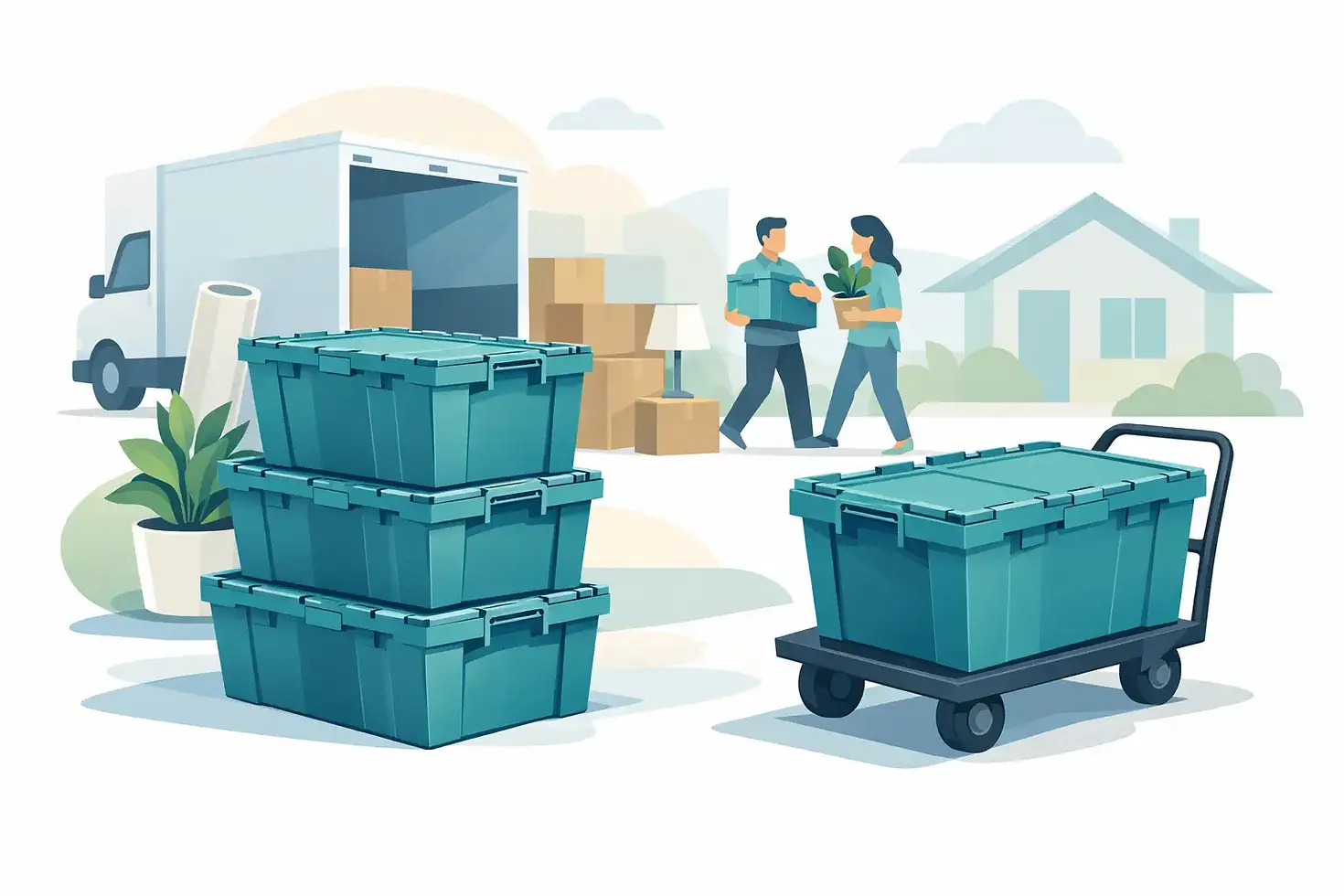
Plastic Boxes for Moving Make Moving Easier

The pile usually starts in the hallway: flattened cardboard, a roll of tape that has disappeared again, and boxes of questionable strength collected from shops and neighbours. Plastic boxes for moving replace that scramble with a ready-to-pack system. They arrive clean, assembled, and sized to stack properly, so you can start packing when it suits your schedule.
For a local move, that changes more than the packing experience. It can make loading safer, reduce time spent hunting for supplies, and prevent the familiar post-move problem of a mountain of cardboard waiting to be broken down, stored, recycled, or thrown away.
Why plastic boxes for moving work differently
A cardboard box is designed for a single journey. It may do the job, but it relies on careful assembly, enough tape, dry weather, and gentle handling. Once it has been packed, lifted, stacked, and unloaded, its corners can soften and its shape can weaken.
Reusable plastic moving boxes are built for repeat use. Their firm sides hold their shape, their lids interlock, and their uniform dimensions create a stable stack in a living room, elevator, moving truck, or storage area. Instead of wondering whether the bottom of a box will hold, you have a container designed for the work.
That structure matters most when moving day becomes busy. Friends arrive, a moving company starts loading, rain appears, and the last few kitchen items still need a home. Solid containers are easier to carry consistently because ergonomic handles are built into the box rather than cut into thin cardboard. They also resist crushing and moisture better than standard cardboard, which offers practical protection for books, dishes, electronics, linens, and everyday household items.
Plastic is not a magic answer for every item. Oversized lamps, mirrors, artwork, and furniture still need the right specialty protection. Fragile belongings should still be wrapped and packed with care. The advantage is that the container itself is one less variable to worry about.
Start with a box plan, not a last-minute box hunt
Most moves become harder when packing supplies are treated as an afterthought. A better approach is to estimate what you need before the final week, then have the boxes delivered while you still have time to sort room by room.
Think about the contents of your home rather than its square footage alone. A one-bedroom apartment with a book collection, hobby supplies, and a full kitchen may need more boxes than a sparsely furnished two-bedroom home. Families often need extra capacity for toys, clothing, pantry items, school supplies, and the many things stored in closets that are easy to overlook.
Use a simple rhythm: pack the items you use least first, keep daily essentials accessible, and leave a small set of clearly marked boxes for the final day. Seasonal clothing, books, decor, spare bedding, and rarely used kitchen equipment are good early candidates. As moving day gets closer, pack room by room instead of creating mixed boxes from all over the home. It makes unpacking far less chaotic.
Uniform containers help here because they remove the question of which box should hold what. You can create stable, predictable stacks instead of trying to fit a tall, narrow carton on top of a soft, overfilled one. Keep heavier items, such as books and canned goods, in manageable quantities. A strong box can carry weight, but your back still has limits.
Delivery, packing, moving, pickup
The practical appeal of a rental system is not only the box material. It is the fact that the process is managed around your move.
First, choose the number of boxes and delivery timing that fit your household. The containers arrive at your door ready to use, with no folding tabs or tape required. That saves time at exactly the point when most people are trying to coordinate cleaners, keys, utility changes, and moving help.
Next, pack and move. Close the interlocking lids, label each container clearly, and stack them with the heaviest boxes at the bottom. Labels are worth the few extra minutes they take. Write both the destination room and a short contents note, such as “Kitchen - mugs and glasses” or “Main bedroom - winter clothes.” When a box has to be opened first, mark it clearly instead of relying on memory after a long day.
After you are settled, the boxes are picked up. There is no need to flatten cartons in a new home that already feels full, no need to find space to store them, and no late-night trip to recycling. Panda Moving Boxes keeps the process straightforward for Greater Victoria movers: boxes are delivered, used for the move, then collected when you are done with them.
Better protection in real moving conditions
Moving does not happen in a controlled warehouse. Boxes get slid across floors, carried through narrow doorways, loaded into vehicles, and stacked around awkward household items. Even a careful move includes bumps, pressure, and changing weather.
Industrial-grade plastic containers help create a more dependable barrier against those conditions. Their rigid construction is less likely to collapse when stacked, and their lids help keep dust and light moisture away from the contents. This can be especially useful during a Victoria-area move, where a dry forecast can change quickly and a cardboard box left near a damp entryway may absorb moisture fast.
The stackable design also makes better use of truck space. When containers sit squarely together, movers can build stable rows rather than filling gaps created by mismatched boxes. That does not eliminate the need to secure a load, but it makes the job more orderly and can reduce shifting during transport.
For fragile items, use the same sensible packing habits you would with any container. Wrap glassware individually, cushion empty space so contents cannot rattle, keep plates on their edges rather than flat, and avoid overfilling. Plastic boxes provide a stronger outer shell, but thoughtful packing inside is what protects the details.
The waste question is practical, not just environmental
Cardboard is recyclable, but recycling does not make the process effortless. Before a move, boxes need to be sourced, carried home, assembled, taped, and sometimes replaced when they are damaged. Afterward, they need to be broken down and moved out again. If they are wet, torn, or contaminated, not every box will be accepted for recycling.
Reusable containers avoid that one-use cycle. A box designed to be used hundreds of times can serve many households before it reaches the end of its working life. That means less disposable packaging tied to a move, without asking you to compromise on convenience.
There is a practical trade-off: rented boxes need to be returned on schedule, so they are not the right choice if you want long-term storage containers sitting in a garage. For most residential moves, though, that is a benefit. It creates a natural deadline to unpack the essentials and keeps empty boxes from becoming clutter in the new home.
A calmer way to finish moving day
The best packing system does not make moving effortless. You still have decisions to make, belongings to sort, and a new space to set up. What it can do is remove a layer of avoidable friction.
When your boxes arrive ready to pack, stack securely, and leave through a scheduled pickup, the move has a clearer beginning and end. Start with the room you use least, label as you go, and give yourself more packing time than you think you need. A well-organized move rarely comes from rushing at the end. It comes from making the next step easy enough to begin today.


Comments