How to Stack Packed Containers for a Safer Move

A stack that looks fine in the living room can shift quickly at a curb, on a ramp, or during one firm stop in the moving truck. Knowing how to stack packed containers is less about building the tallest possible tower and more about creating stable, easy-to-handle loads that protect your things from door to door.
Reusable plastic moving containers make this simpler. Their matching footprint, firm sides, and interlocking lids are designed to work as a system, unlike a collection of cardboard boxes in slightly different sizes. Still, good results depend on how you pack, close, lift, and load them.
Start with containers that are ready to stack
Stacking begins while you pack. A container should be full enough that its contents will not slide around, but not so full that the lid bows, catches, or will not close flat. Fill gaps around dishes, small appliances, and decor with towels, packing paper, or soft linens. This protects the item inside and helps the container keep a balanced load.
Keep the weight reasonable. Books, tools, canned goods, and records add up quickly, even in a durable container. Spread dense items across several boxes and use lighter belongings, such as bedding or clothing, to fill the remaining space. A stack is only as safe as the person lifting the container at its base.
Before adding any container to a stack, check three things: the lid is fully closed, the handles are clear, and nothing is protruding. A loose lid or a lamp cord caught at the edge can prevent containers from seating properly. It can also make unloading harder when you are tired and working in a tighter space.
How to stack packed containers safely
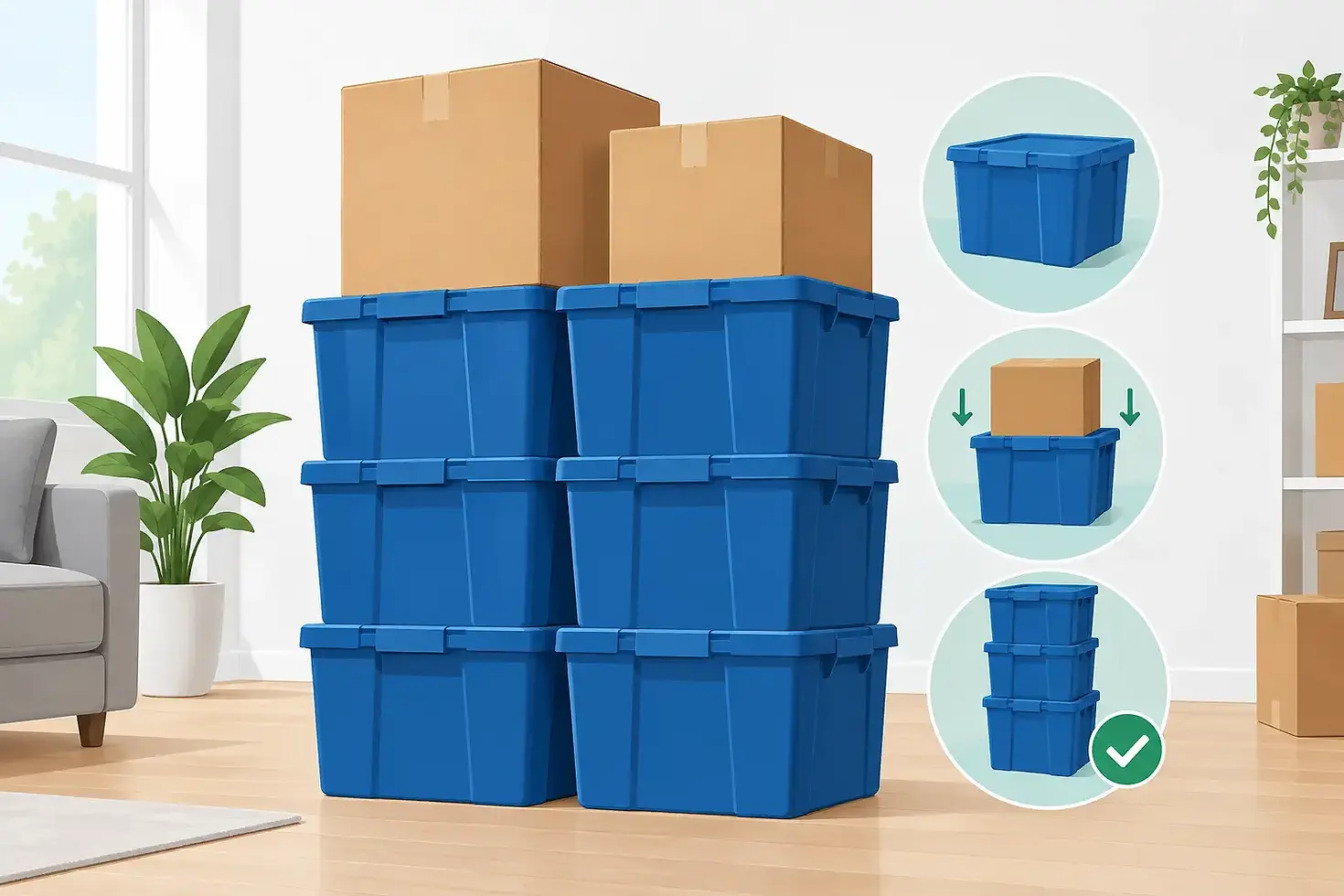
Build every stack from the floor up, with the heaviest, most compact containers at the bottom. Place lighter containers above them. This basic order lowers the centre of gravity and stops a dense box of books from pressing into softer, lighter contents below.
Use containers of the same size whenever possible. Matching modular containers sit squarely on one another, with no overhang to create a tipping point. Set each container down gently and make sure it is aligned with the one beneath it. Interlocking lids help reduce sideways movement, but they are not a substitute for a level, properly aligned stack.
Avoid making one very tall column just because you can. The right height depends on where the stack will sit, how much it weighs, whether children or pets are nearby, and how it will be moved. A lower stack is usually the better choice in a busy home, near a doorway, or anywhere people will pass repeatedly. If you need to move containers by hand, build stacks that can be separated comfortably rather than treating them as one unit.
Fragile containers need special attention. Label them clearly on more than one side, keep them upright if their contents require it, and place them on a firm, level container. They may belong near the top of a stack, but only if the stack is stable and there is no risk of other items being placed on them later. Fragile does not always mean light - a well-packed dish container can still be heavy.
Keep stacks out of the traffic flow
The safest stack is one nobody has to squeeze around. Choose a staging area against a wall or in a low-traffic room, leaving a clear route to the exit. Keep containers away from stairs, exterior doors that may swing open, and narrow hallways. This makes the move safer and lets movers or helpers work at a steady pace.
Do not stack on soft carpet if the pile is tall or heavily loaded. Carpet can compress unevenly, particularly over underlay, causing a stack to lean slightly. A hard, level floor is ideal. If your only practical packing area is carpeted, keep stacks lower and check them periodically as you add containers.
It also helps to organize by destination room before move day. Group kitchen containers together, bedroom containers together, and so on, then label the visible sides. You will spend less time moving stacks around to find a specific box, and unloading becomes more orderly at the new home.
Load the moving vehicle with balance in mind
A secure household stack is not automatically secure in a truck or van. Once the vehicle starts moving, every container is affected by braking, turns, slopes, and road vibration. Load the heaviest containers low and distribute weight evenly across the vehicle rather than concentrating everything on one side.
Start at the front of the cargo area and work toward the rear. Place stacks against a firm surface where possible, keeping container faces flush and aligned. Do not leave empty gaps around a stack if you can avoid it. Fill those spaces with other stable containers or suitable soft items so the load cannot gain momentum and shift.
Keep stacks below the vehicle's interior height and never force containers beneath a ceiling, shelf, or door mechanism. In a rental truck, follow the vehicle provider's loading and tie-down instructions. Use the available anchor points and straps where needed, especially around larger furniture and open spaces. Straps should secure the load without crushing lids or pressing hard against fragile contents.
Furniture and containers can work together, but placement matters. A heavy dresser, appliance, or table should not rest on a container lid unless the equipment is specifically designed for that load. Put heavy furniture directly on the truck floor, protect its surfaces with moving blankets, and use containers to fill stable spaces around it. This approach protects both the furniture and the stack.
Use the right lifting routine
Even sturdy plastic containers are safer when lifted one at a time. Face the container, bend your knees, grip both ergonomic handles, and hold the load close to your body as you stand. Avoid twisting while carrying. Instead, take small steps and turn your whole body toward the destination.
For stairs, reduce the weight rather than trying to save trips. Keep the route clear, use good lighting, and make sure the person walking backward has a clear view or a spotter. Never carry a container that blocks your sightline on a staircase. If a container feels awkward, it is better to repack it before move day than to wrestle with it on the landing.
When working with friends or professional movers, agree on a simple rule: one person directs the stack and everyone respects the labels. That prevents a carefully organized fragile stack from becoming the base for a last-minute box of garage tools.
Watch for the small signs of an unstable stack
Pause and rebuild a stack if it leans, rocks when touched, has misaligned edges, or contains a lid that is not sitting flat. These are quick fixes when the containers are still in a room. They become bigger problems once the load is in a vehicle or halfway up a flight of stairs.
Be especially cautious after moving containers from a cold garage, damp entryway, or uneven outdoor surface. Wipe away moisture before stacking, and do not rely on a wet or sloped driveway as a staging area. Plastic containers resist water damage far better than cardboard, but safe handling still requires dry grips and stable footing.
Make unloading easier on the other side
At your new place, bring containers in by room instead of building a temporary mountain in the entryway. Start with the heavy base containers, then add lighter ones if you need short-term stacks. Keep essentials - bedding, medications, chargers, kettle supplies, and basic toiletries - separate and accessible so you are not opening multiple stacks on the first night.
Panda Moving Boxes are built to stack securely, but the best moving system is one that stays manageable from packing day through pickup. Build low, balanced stacks, keep your pathways clear, and give every container a stable place to land. Your future self will appreciate the extra two minutes spent lining up the first stack.


Comments